Just in time for the holidays and for a limited time only, the MKI drastically reduces the prices of some of its popular books, when ordered directly from the UW Press: click on the link below, add to cart, add promo code KADE11, click checkout and the new price will appear.
"Pickled Herring and Pumpkin Pie: A Nineteenth-Century Cookbook for German Immigrants to America," paper, now $14.95.
"German Jewish Identities in America," cloth, now $14.95.
"Land Without Nightingales: Music in the Making of German America," cloth with CD, now $19.95.
"Atlas of Pennsylvania German," cloth, now $19.95.
"Other Witnesses: An Anthology of Literature of the German Americans, 1850-1914," cloth, now $19.95.
Monday, October 31, 2011

Wednesday, October 26, 2011
Foremothers: Genealogy and Gender

Friday, October 14, 2011
The MKI Library Project Campaign
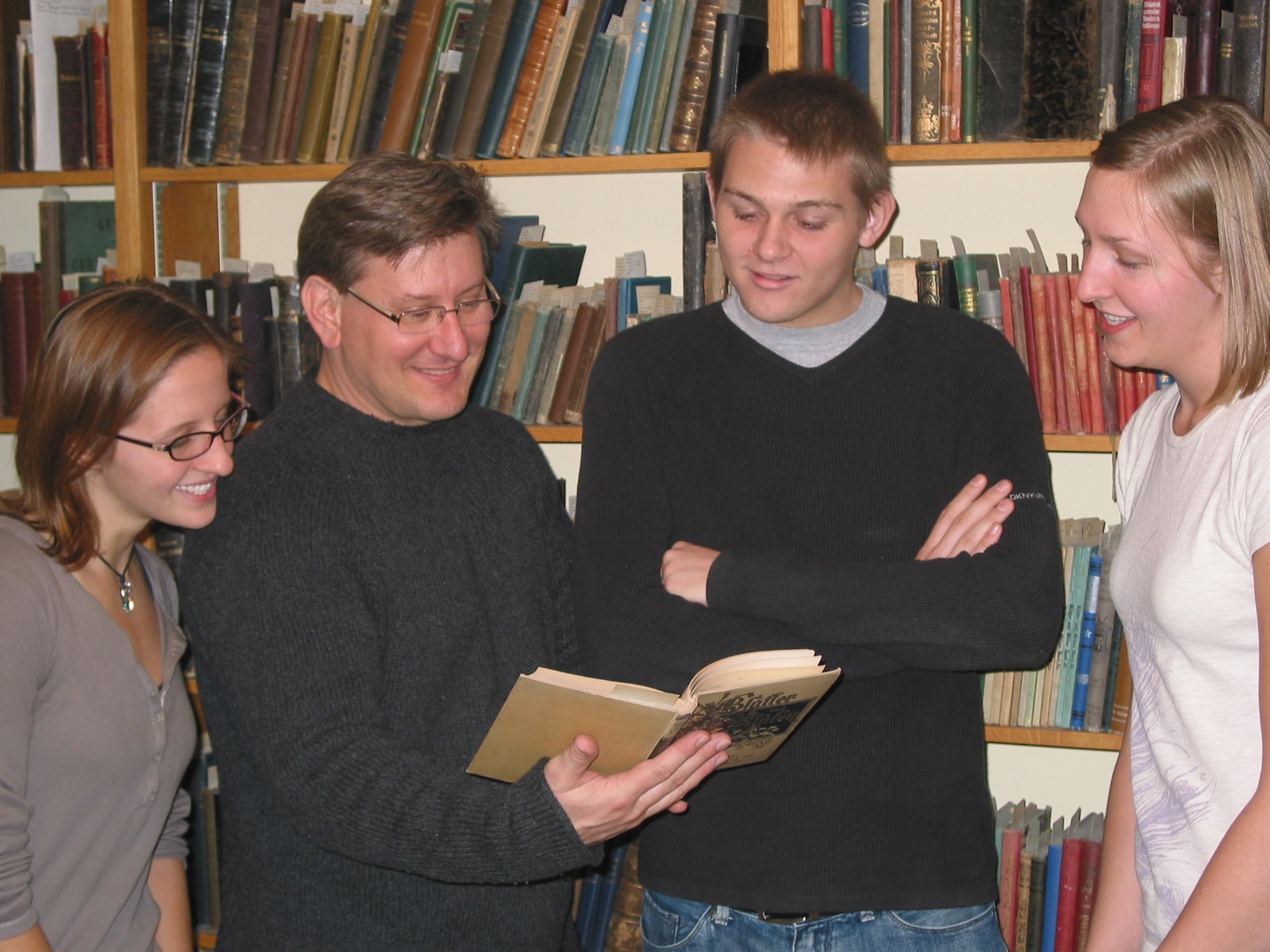 We are almost there! As many of you have heard, the Max Kade Institute is now moving to a much larger and more centrally located place on the UW–Madison campus: the University Club. We are using this opportunity to build a state-of-the-art library and archival facility for our unique collections of German-language materials published in North America, including an exhibit space and comfortable reading areas for our patrons. The renovation is budgeted at $1.1 million, and we are within reach of our goal. Please help us preserve this important part of American history and support our efforts to raise the final $200,000.
 HELP US RAISE $200,000
Through the end of 2011 all donations will be matched dollar for dollar by the University of Wisconsin–Madison.
· Gifts can be made by check, made out to UW Foundation, with MKI Library Project in the memo line and mailed to: Max Kade Institute, 901 University Bay Dr., Madison, WI 53705
· or online through the MKI Web site: http://mki.wisc.edu (click on “MKI Library Campaign”).
All gifts to the MKI Library Project are fully tax deductible.
Tuesday, September 27, 2011
When is a man a German American?
 The above question-and-answer comes from the February 1889 issue of Das Evangelische Magazin, edited by C. A. Thomas and R. Matt and published in Cleveland, Ohio, by Lauer und Mattill. Such inquiries appear in the magazine’s “Mit unsern Lesern” section, and while the majority of them are of a religious nature, occasionally something more secular appears. Here a reader from Missouri asks if a man born in America to German parents is a German-American or something else. The editors proclaim that such a person would be as much an American as if his parents had come on the Mayflower with the Puritans. They offer the distinction that a German-American would be someone who was born in Germany, but either naturalized here or became a citizen through the citizenship of his father. The situation, they point out, would be the same for anyone from any other country; but if you are born in America you are simply an American, even if your father was an English lord or an Italian count.
An interesting emphasis on the democratization of America, though perhaps a bit disappointing for those of us today who wish to proudly identify our ethnic heritage, or perhaps even wish to bask in the glow of a presumed noble “von.”
A bit of research into the history of the magazine itself reveals it was published from 1869 through 1927 under several different editors and publishers (although the location of the publishers, despite name changes, was always given as 265-275 Woodland Avenue. This, we discovered was the home of the Publishing House of the Evangelical Association, which produced materials in both English and German). We were also able to discern that R. Matt was Robert Matt, but haven’t been able to yet learn much about him. We did find some information in the 1894 Congress of the Evangelical Association on C. A. Thomas: “Rev. C. A. Thomas, at the head of the publishing interests of the Evangelical Association, was born in Germany in 1840 and came to this country when a boy of fourteen. He entered the ministry in 1859, was elected Presiding Elder in the Spring of 1879, and in the Fall of the same year editor of Das Evanglische Magazin and German Sunday-School literature, Cleveland, Ohio, which office he still holds.” This image of C. A. Thomas was also provided:

We’d like to learn more about Thomas and Matt, and about the German-language activities of the Evangelical Association – if you have information you’d like to share, do contact us at the Max Kade Institute for German Studies in Madison, Wisconsin!
Thursday, August 25, 2011
International Plattdüütsch Konferenz in Wausau, Wisconsin
 This year, September 9-11, the 16th Annual International "Plattdüütsch" Conference will be held in Wausau, Wisconsin. Hosted by the Pommerscher Verein Central Wisconsin, the conference will feature talks on the history and characteristics of the Low-German dialects and the culture and traditions of "Platt" speakers around the world. The Max Kade Institute will be represented with an exhibit and talks by Professor Mark Louden and Antje Petty. And there will be plenty of opportunity to have a good time with music, dance, "Platt" demonstrations, and - of course - good food. For more information and a detailed program click here (PDF).
German-American Comedy Songs on the National Jukebox

The National Jukebox
According to Prof. James Leary of the University of Wisconsin-Madison, dialect recordings associated with German Americans (or the "Dutch" as the English of the 18th and 19th centuries referred to anyone from a wide range of Germanic regions) entertained and appealed to both German-American audiences and mainstream Americans.
Take some time to listen to comic songs, skits, and recitations such as "The Germans' Arrival," "Hans Krausmeyer and His Dog Schneider," "Krausmeyer's Wedding Party," "Louisa Schmidt," "Fritz and Louisa," "The Happy German Twins," and "It Takes the Irish to Beat the Dutch." Some of these recordings may also be found and listened to by searching for "German dialect" or "Dutch dialect" on the Cylinder Project site at University of California-Santa Barbara
You may also wish to read Prof. Leary's paper, "Dialect Songs among the Dutch" [PDF] and listen to audio samples associated with the work
And to examine German-American ethnic stereotypes through cartoon images found on popular postcards in the 20th century, see:
Tuesday, August 23, 2011
Germany Reports on German Heritage in Wisconsin
 I always find it interesting what German papers report on German history and traditions in America. Over the summer germany.info, the official Web site of the German Missions in the United States, did a series on German heritage in Wisconisin. Read what they have to say about "Bierbrauer vs. Piraten," "Appleton's Ancestral Ties to Germany," and "30 Years of Milwaukee's Original Haus Party."
Thursday, April 14, 2011
Some Things Remain Much the Same. . .
As America commemorates the sesquicentennial of its Civil War, we at MKI are poring over the materials in our collections to illuminate how the events of this era were documented by German speakers in America and in Europe. The following comes from the Geschichte des Tages (Events of the Day) section of the August 4, 1855 Illustrirte Abend-Schule, published in Buffalo, New York. While still several years before the outbreak of armed conflict, this summary of the mood in German America is telling:
America: Party politics, temperance litigation, murders, railroad and steamship disasters – and that's it.

America: Party politics, temperance litigation, murders, railroad and steamship disasters – and that's it.
Tuesday, March 22, 2011
Friends of the Max Kade Institute 2011 Annual Meeting ---- St. Nazianz Village, Manitowoc County

Join us on Saturday, May 7, for our annual meeting and an exciting day in Manitowoc County where we will visit St. Nazianz, the site of the Oschwald communal society you have read about in your newsletter. A guided tour will include St. Gregory’s Catholic Church and cemetery; a walk through the village, a visit to the local museum; and a stroll to the old Salvatorian property just south of the village, where we will hold the Annual Meeting. We will conclude the day with supper at the Silver Valley Banquet Hall just west of Manitowoc.
1:30 – 2:00 Registration at St. Gregory's Church, 214 Church St., St. Nazianz, WI
2:00 – 4:00 Tour of St. Nazianz village and Salvatorian property
4:00 – 5:00 Annual Meeting and social time (followed by brief Board of Directors meeting)
5:00 – 5:30 Drive to Silver Valley Banquet Hall, 1222 S Alverno Rd. Manitowoc, WI
5:30 Dinner at Silver Valley Banquet Hall (Buffet with a variety of German dishes)
Please register by April 30th -- click HERE for PDF with registration form and driving directions
Friday, March 11, 2011
University of Heidelberg Honors American Abolitionist and Former Slave
 By establishing the James W.C. Pennington Distinguished Fellowship, the University of Heidelberg/Germany is drawing attention to a long forgotten historic occurrence that brought together German democratic revolutionary ideals, the international peace movement and the abolitionist movement in America. In 1849, James W. C. Pennington became the first African American to be awarded an honorary degree from a European University when the University of Heidelberg conferred on him the honorary doctorate of divinity. He had been invited to Heidelberg by the theologian and democratic activist Friedrich Wilhelm Carové after the two met at the 1849 World Peace Congress in Paris.
Pennington was born in 1807 as Jim Pembroke, a slave on an estate in western Maryland, and later worked as a blacksmith. He escaped bondage as a young man, fled north, was able to educate himself, and became the first African American to attend classes at Yale. He was eventually ordained as a Presbyterian minister. In 1849, he published The Fugitive Blacksmith, or Events in the History of James W. C. Pennington, an account of his harrowing escape. With his oratory and literary skill, Pennington became a leading voice for the abolitionist movement, representing its Evangelical Christian branch.
According to Dr. Mischa Honeck, Assistant Professor at the University of Heidelberg’s Center for American Studies, Pennington’s honorary degree from Heidelberg not only raised his prominence in the abolitionist movement in the US, but it also was seen as a positive tool for the foundering cause of German liberalism. More information can be found here.
Monday, January 31, 2011
German and German-American Dimensions of the Civil War

2011 is the year of the sesquicentennial of the beginning of the American Civil War. The Max Kade Institute will mark the occasion by hosting an international symposium to examine the time before, during and directly after the Civil War from a unique angle, focusing on immigrants (especially those from German lands) and the global impact of the war (especially within German-speaking Europe). Join us March 3-5 at the University of Wisconsin Memorial Union and the Wisconsin Veterans Museum in Madison. For a detailed program and abstracts of presentations see the MKI Website.
Friday, January 21, 2011
Music of the Old Order Amish
On February 10 at 7pm, Professor Mark Louden (German Department, University of Wisconsin) will hold a lecture on "Music of the Old Order Amish." Professor Louden will give an overview of the variety of forms of musical expression among the Amish, which show influences from both Central European hymnody and nineteenth- and twentieth-century American gospel music. An experience "Vorsaenger" (lead singer) himself, Professor Louden will demonstrate how Amish songs are led in worship and at Sunday evening social gatherings. Join us at the Memorial Union on the UW-Madison Campus!
Wednesday, January 19, 2011
Immigrant Entrepreneurship: German-American Business Biographies, 1720 to the Present

An ambitious project coordinated by the German Historical Institute in Washington, D.C., will highlight the role played by immigrant entrepreneurs—specifically those who came from German-speaking lands—in the development of America's economic success. The project will utilize a wide range of source materials to provide biographical sketches as well as company histories for businesses from the early eighteenth century to the present day; the information will be presented online free of charge. All entries are to include information concerning the individual's reasons for migration; his or her social origins, regional identity (either in the home country or in the U.S.), religion, ethnic networks, Americanization, and business strategies; the impact of problems in America such as nativism, anti-German sentiments, boycotts, and anti-Semitism; and also the business's development and change over time.
The site is in progress at: http://www.immigrantentrepreneurship.org/
Thursday, January 6, 2011
Announcing: Anglo-German Walks 2011

Submitted by MKI Friend JoAnn T.
Neil McDonald, a German teacher from Yorkshire, England is an experienced hike leader and has organized cross-cultural walking weeks for adult participants since 1993. Both English and German native speakers share a week of language, culture, and most-importantly, hiking in the British Isles and German-speaking areas on the continent. I participated last June in the German-speaking Italian Alps (Südtirol), hiking in the area around Meran (see picture) and have fond memories of following the splashing Waalwege downhill and stopping for refreshment at Gasthäuser with unforgettable views!
Destinations for 2011 are the Höllental im Schwarzwald (Black Forest), Dahner Felsenland (Pfalz), Sächsische Schweiz (Saxon Switzerland) and Harzgebirge (Harz Mountains), as well as Exmoor, the Welsh Marches, the Scottish Southern Uplands, and Hadrian’s Wall.
Find more information and request a brochure at:
www.anglo-german-walks.com.
Tuesday, December 7, 2010
Instruction in German in American Schools

In the 19th and early 20th centuries, the Midwestern landscape of America was dotted with schools whose language of instruction was not English, but German, Polish, Norwegian, or something else. The library and archive of the Max Kade Institute contain numerous German-language school materials used in North America, such as primers; study guides for the German script; textbooks for learning math, science, and other subjects; readers for young adults; report cards; and more.
Now we would like to learn more, and wish to gather stories, anecdotes, and experiences of those who were taught in the German language in American schools.
If you attended a German-language school, or have stories of family members who received German-language instruction, please contact Antje Petty at: apetty(at)wisc.edu
If you know someone who has stories they'd like to share, do please send us contact information for them!
---
Thursday, December 2, 2010
German Christmas Traditions "at the Inn"
 If you are in South-East Wisconsin this weekend, check out Christmas at the Inn at the Dousman Stagecoach Inn Museum, 1075 Pilgrim Parkway in Brookfield, Wisconsin. On Saturday (10am-4pm) and Sunday (noon-4pm), the Elmbrook Historical Society showcases Christmas traditions from Bavaria, Hesse, Pomerania, and the Danube settlements (Donauschwaben), - four European regions, from which many German-speaking immigrants in Wisconsin came from.
Friday, November 19, 2010
Germanic Languages and Migration Network (GLaM)
The Max Kade Institute is actively involved in "Germanic Languages and Migration" (GLaM), an international and interdisciplinary network. Realizing that language changes constantly, and that it is not confined by national boundaries, the network brings together scholars from a variety of fields (sociolinguistics, linguistic anthropology, education, cultural studies, cultural geography, media studies, among others) to study the relations between language, migration, and transnationalism. Now two virtual seminars that grew out of a collaboration between the MKI and the Universities of Leeds and Southampton have been posted online: "Social Networks and Language Contact in the Early Modern Dutch Republic" by Professor Robert Howell, UW-Madison; and "The Times of Their Lives: Time, Place, and Space in Central European Language Biographies" by Professor Patrick Stevenson, University of Southampton. Also check out the "New Glarus Heritage Tour."
Thursday, August 26, 2010
Immigrant Names

According to one enduring myth, the surnames of many immigrants (including German immigrants) were anglicized or changed at Ellis Island. Not so! On the contrary, immigration officials at Ellis Island meticulously recorded names exactly as they were written on ship lists or other documents the immigrants brought with them. Only rarely and mostly because of transliteration questions, names were spelled differently our changed. An interesting article "New Life in America no Longer Means a New Name" in the New York Times looks at why some immigrants with ethnic names have opted for a change. The paper comes to the conclusion that these name changes today are rare, and if they occur, it is mostly for personal reasons (the wish to use a spouse's name for example) rather than a wish to disassociate with an ethnic name.
Tuesday, July 6, 2010
September 2010 Conference: Investigating Immigrant Languages in America

Investigating Immigrant Languages in America
September 16-17 (Thursday and Friday), 2010
in the Memorial Union on the University of Wisconsin–Madison campus
Free and open to the public
This event will bring together a set of scholars with the aim of creating new collaborations in linguistics and related areas.
Wisconsin has a long tradition of research into immigrant languages in North America, led by luminaries like Einar Haugen (Scandinavian Studies), and others including Frederic Cassidy (English / Dictionary of American Regional English) and Lester W.J. Seifert (German).
Haugen, a Norwegian-American bilingual from the Upper Midwest, was one of the creators of modern sociolinguistics, and made great contributions to our understanding of language structure, bilingualism, language contact, and language history. Building directly on that tradition, this conference will present new research in all these areas, including a presentation on Haugen’s work, founded on insights in his Bilingualism in America.
The conference aims to reach two distinct audiences. The first day focuses on linguistics, more directly intended for linguists faculty and students. Particular attention will be on syntax, an area long ignored in the study of immigrant languages. The second day aims to attract and engage a broader public, including language learners, members of heritage communities, and those interested in American dialects.
(Please see Today in the Union [TITU] for room information on days of conference.)
Click here for conference details and schedule (PDF).
Monday, January 4, 2010
Dance Halls in Texas

A recent report on National Public Radio has brought our attention to efforts to restore and preserve dance halls in Texas, most of which were built by German or Czech immigrants, although some are the handiwork of African Americans. Featured in the NPR story is the effort to restore Sengelmann Hall in Schulenburg, between Houston and San Antonio. Built in 1894 by German-speaking settlers, it closed during World War II and hadn't been danced in for more than 60 years. The NPR story can be read and heard online here, while an informative database of Texas dance halls can be viewed on the Web site of the Texas Dance Hall Preservation Inc.
Friday, December 18, 2009
Herta Müller, 2009 Nobel Prize Laureate in Literature, and the Story of her Ancestors' Migration
 On December 10, Herta Müller accepted the 2009 Nobel Prize in Literature in a ceremony in Stockholm. When the award winner was announced in the fall, many asked: “Who is Herta Müller?” Her selection may have come as surprise, but the timing was no coincidence. 2009, after all, is the year of the twentieth anniversary of the fall of the Berlin Wall and the end of communism in Europe, and much of Herta Müller’s work focuses on life in Romani
 a under the repressive Ceauşescu regime. Her perspective is that of a member of the Romanian-German minority population, and she writes in German.
Herta Müller grew up in the small village of Nitchidorf in Romania in a German-speaking family and a German-speaking community that was founded by immigrants from Southwest Germany over 200 years ago...
Read the complete article here
Image 1: germanyinfo.de; Image 2: nitzkydorf.de
Subscribe to:
Posts (Atom)


